

Happy Birthday to You by Stevie Wonder - For Ukulele
Intro
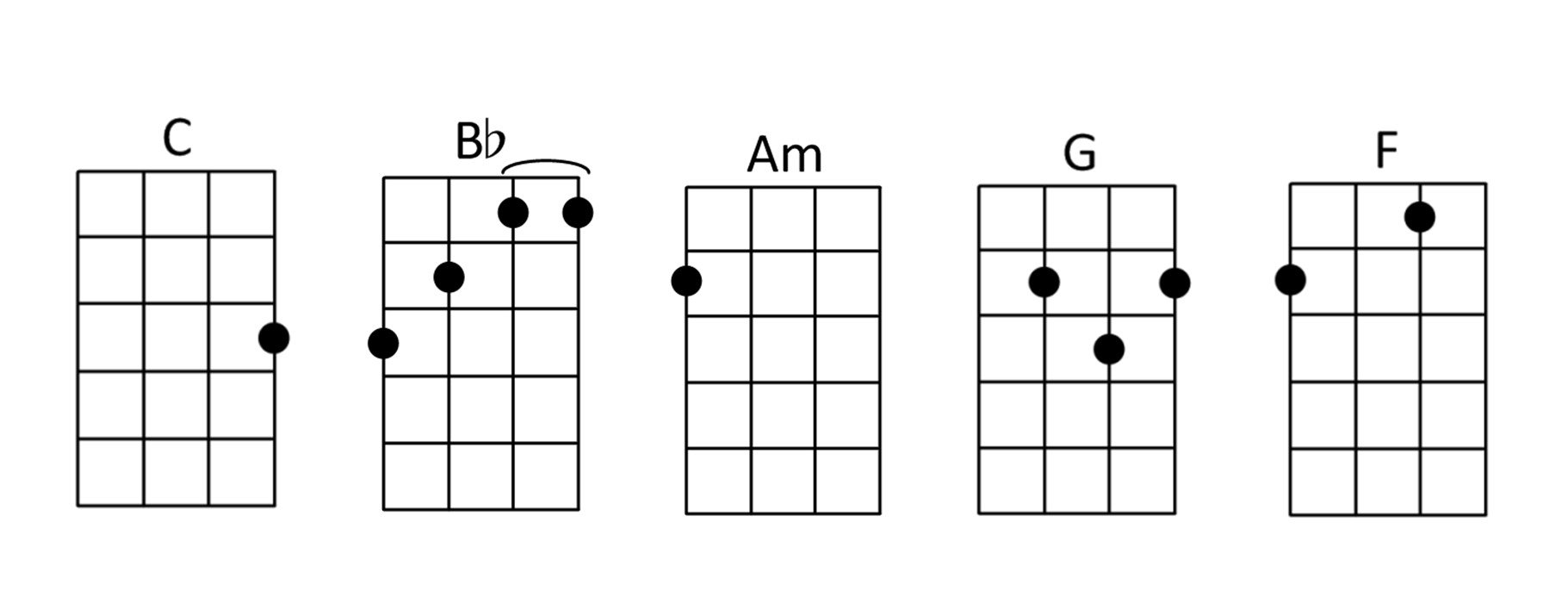
C Bb Am G F
C Bb Am G F
Verse 1
You know it [C]doesn't make much sense
There ought to [Bb]be a law against
Any- [Am]one who takes offense
At a [G]day in your [F]celebration
Verse 2
Cause we [C]all know in our minds
That there [Bb]ought to be a time
That [Am]we can set aside
To [G]show just how [F]much we love you
Bridge
And I'm [F]sure you would agree
It couldn't [G]fit more perfectly
Than to [F]have a world party on the [G]day you came to be
Chorus
Happy [C]Birthday to you
Happy [C]Birthday to you
Happy [F]Birth- [C]day
Happy [C]Birthday to you
Happy [C]Birthday to you
Happy [F]Birth- [C]day
Verse 3
I just [C]never understood
How a [Bb]man who died for good
Could not [Am]have a day that would
Be [G]set aside for his [F]recognition
Verse 4
Because [C]it should never be
Just be [Bb]cause some cannot see
The [Am]dream as clear as he
that [G]they should make it be- [F]come an illusion
Bridge
And we [F]all know everything
That he [G]stood for time will bring
For in [F]peace our hearts will sing
Thanks to [G]Martin Luther King
Chorus
Happy [C]Birthday to you
Happy [C]Birthday to you
Happy [F]Birth- [C]day
Happy [C]Birthday to you
Happy [C]Birthday to you
Happy [F]Birth- [C]day
(Fade to end)
➡️ Download a PDF of ‘Happy Birthday’
➡️ Get Your Free Ukulele Chord Charts
The Story Behind the Song
The story behind Stevie Wonder's 'Happy Birthday' is much deeper than a simple birthday song.
The song appeared on Wonder's 1981 album 'Hotter Than July'. Rather than being about an ordinary birthday celebration, its lyrics are dedicated to Martin Luther King and an attempt by Stevie Wonder to dedicate a national holiday to him, promoting peace, equality, and unity.
Wonder didn't stop at writing the song. He used it as a rallying cry in a nationwide campaign, organizing events, gathering support, and working alongside civil-rights leaders including Coretta Scott King. According to Wonder, the idea for the song came after a dream in which he imagined performing it while people marched with signs supporting a King holiday.
The campaign succeeded. In 1983, President Ronald Reagan signed legislation creating the federal holiday, and the first official observance of Martin Luther King Jr. Day took place in 1986. Many historians and commentators credit Wonder's song and activism as major factors in building public support for the holiday.
So the song is unusual in music history: it wasn't just a hit record, it helped advance a political and civil-rights campaign that ultimately led to the establishment of a new U.S. federal holiday.